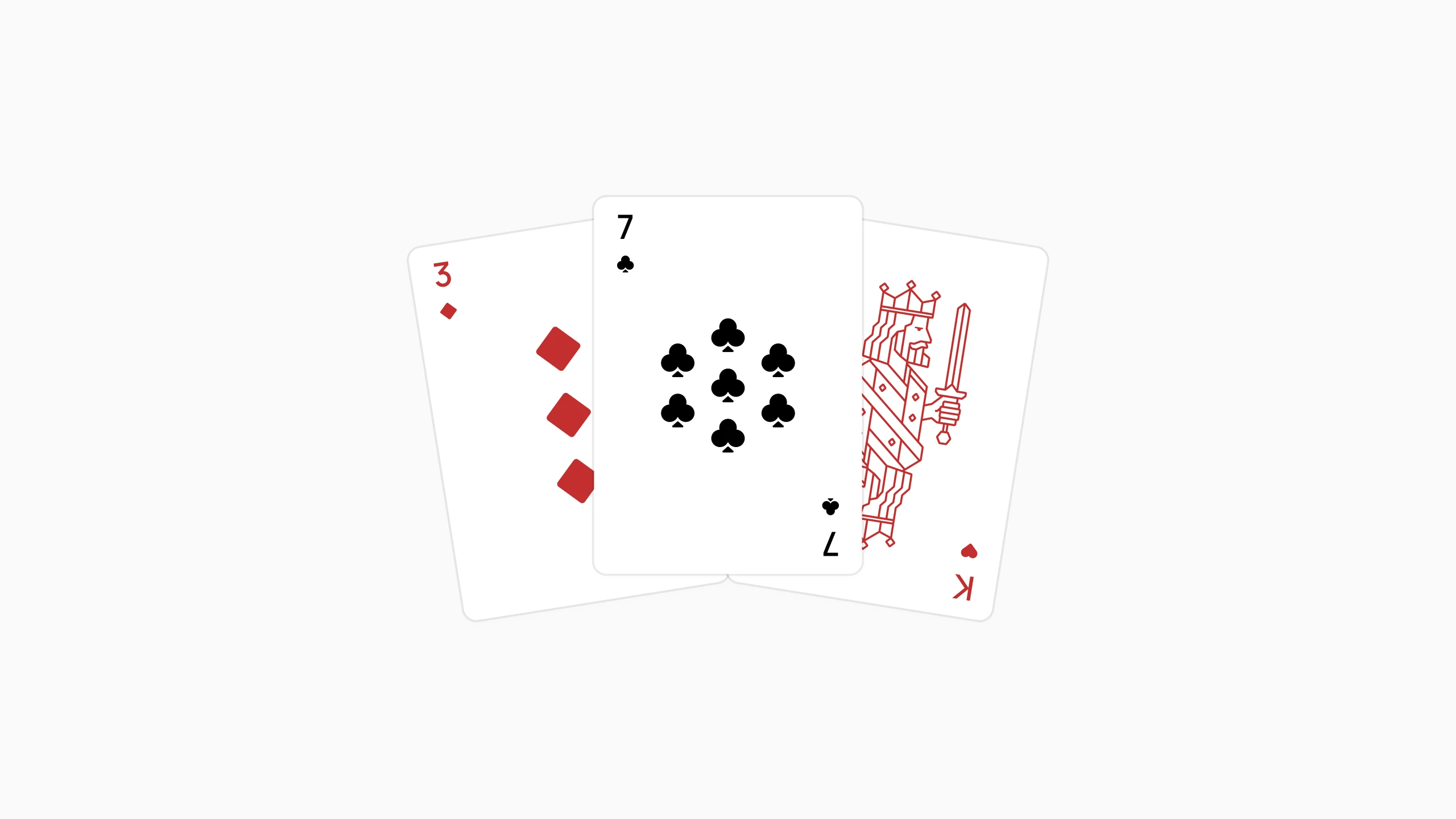
Bisca is the Portuguese cousin of Italian Briscola. It's played with forty cards: ace to seven and three courts in each suit, no 8, 9 or 10. The order isn't the one the faces suggest either. The ace wins, then the seven, then the king, the jack and the queen, and only then six down to two.
I played a lot of it at university, with friends and classmates, and it has been part of our lives ever since. After graduating everyone went their own way, and William came up with the obvious question: why not a Bisca online? He's building the game. I took the visual side, and tried to give it a system rather than a skin.
The cards turned out to be where nearly every decision lived.
One column for the drawing
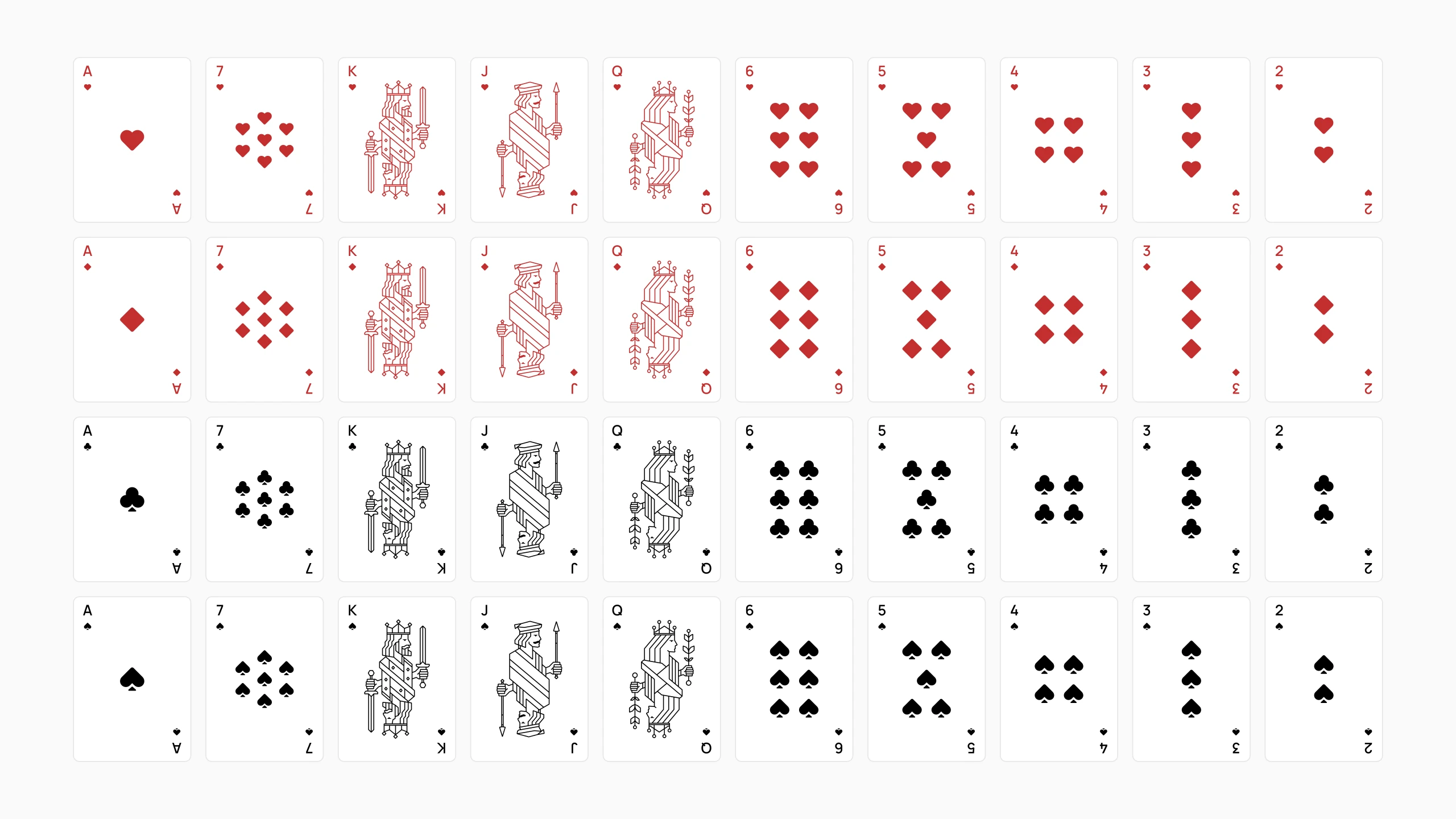
Every card is the same frame: 128 by 180, 8 in, the index in a 14-wide column down each side, and a 72-wide column between them that holds everything else. The index is Manrope SemiBold at 16 over the suit at 12, identical on all forty cards, so after the first hand the eye stops reading it and just finds it.
The pips shrink as they multiply. The ace gets a single one at 40, two to six use 32, and the seven drops to 24 in three columns of two, three and two, because seven rows of 32 don't fit in 164. That makes the seven the one number card with a silhouette of its own, which is fair in Bisca: it's the second strongest card in the deck.
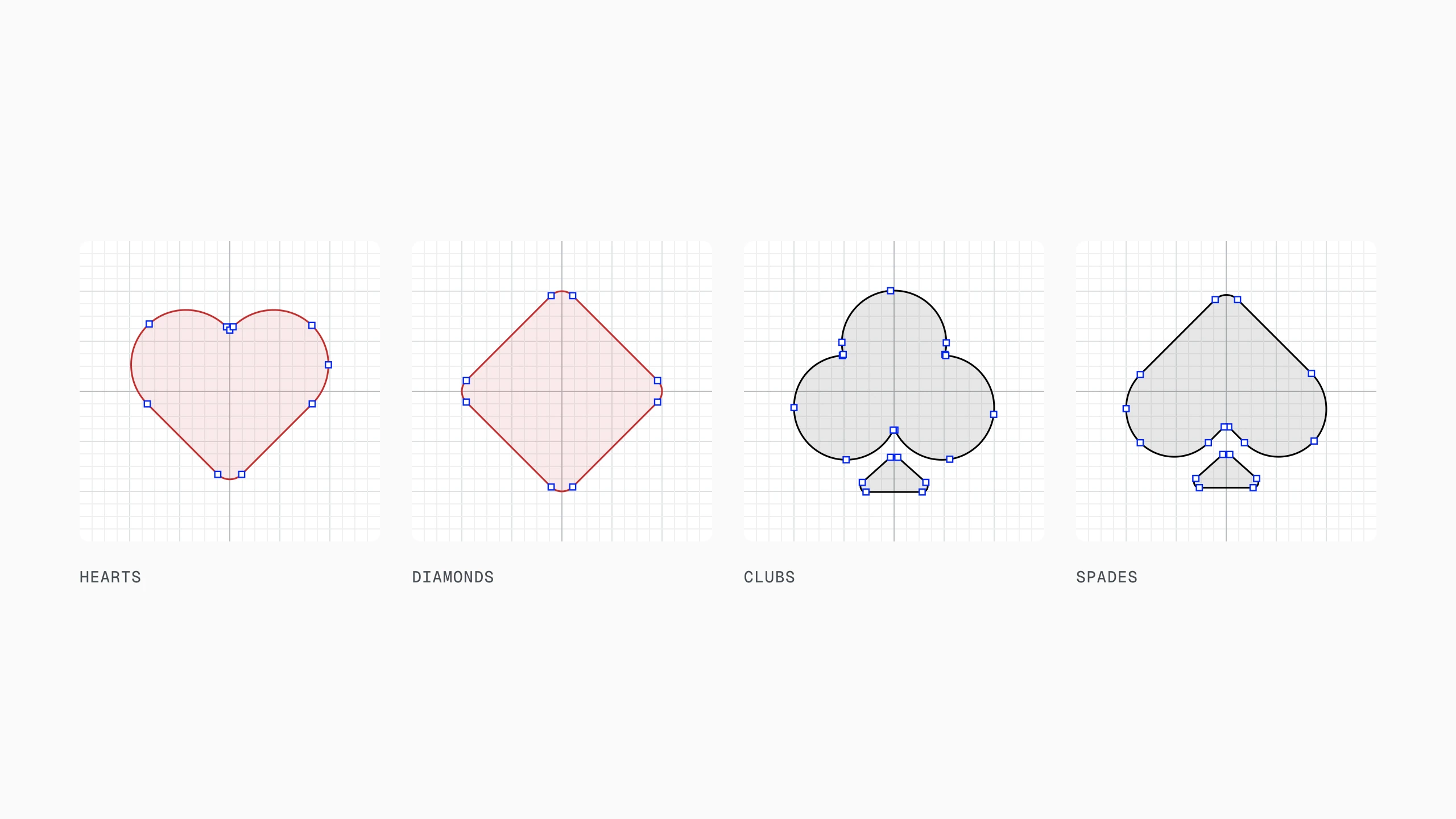
Each suit is a single drawing on a 24 grid, scaled to 12, 24, 32 and 40, so a heart in the corner and a heart on the ace are the same heart. The red is #C22F2F rather than a pure red. Beside the black it reads as ink, not as an alert.
Courts
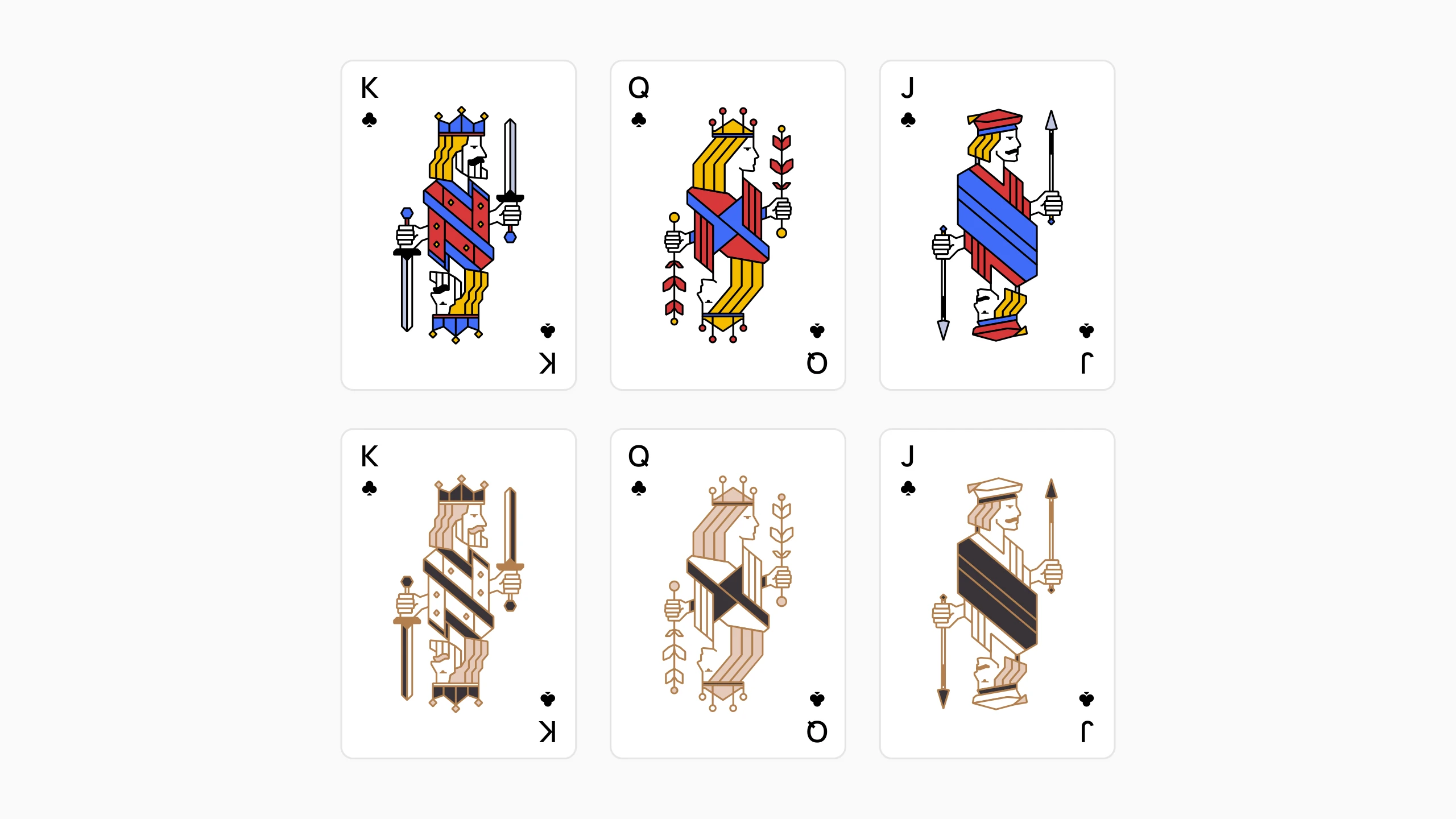
The courts were the hard part. There are six drawings in the deck, a king, a queen and a jack in red and the same three in black, and each one was drawn by hand in Illustrator, line by line, inside the same 72 by 132 the pips use. It was slow, and it was the most fun part of the whole deck.
Hearts and diamonds share the red drawings, clubs and spades the black, and the index in the corner does the rest. One line weight, no fill.
Before the line, the courts were drawn in colour: all three in red, blue and gold, then the same three in a two-tone of cream and bronze.
The colour versions are the better pictures. The line is the better card: it carries the same weight as the pips, so a king in a hand of three sits beside a three of diamonds instead of shouting over it.
A hand of three
Bisca deals three cards, and after every trick each player draws back up to three until the stock runs out. So a hand only ever has three shapes: three cards, two and one. Rather than a formula that fans any number of cards, the game keeps three fixed layouts.
const BISCA_HAND_LAYOUTS = { 1: [{ x: 0, y: 0, angle: 0, zIndex: 3 }], 2: [ { x: -36, y: 7, angle: -6, zIndex: 2 }, { x: 36, y: 7, angle: 6, zIndex: 3 }, ], 3: [ { x: -62, y: 13, angle: -9, zIndex: 2 }, { x: 0, y: 0, angle: 0, zIndex: 4 }, { x: 62, y: 13, angle: 9, zIndex: 3 }, ],};Three numbers a card. The outer cards drop 13 and turn 9 degrees, which is just enough for the three to read as a hand and not as a row. With two left, the drop and the turn roughly halve, so the hand closes up rather than leaving a gap where the played card was.
The focus rule in the Figma notes is two numbers: the card under the pointer at 1.0, the others at 0.94. Shrinking the rest instead of growing the one keeps the focused card at its real size, so its index never slides out from under the eye.
Proximity
The other note says the hand should move like the macOS dock. With three cards it barely shows. With a whole suit in a row it's the difference between a pointer that lands on targets and one that sweeps across them.
Each card measures its distance to the pointer and eases off along a cosine over 120 px: up to 1.18 and 16 px of lift at the pointer, nothing at the edge of the reach, and no corner where the two meet. The stacking order follows the same distance, so the nearest card is always the one on top.
Cards you can't play
This version of the game has two house rules that live in the hand. The trump ace can't be played until the trump seven is out, and the trump seven can't be the last card of a trick. So a card isn't just in the hand or not. It's playable, waiting for your turn, or blocked, and the hand has to say which without a word of explanation getting in the way.
The trump ace waits for the trump seven.
A blocked card doesn't hide. It stays where it was, faded, and a try shakes it once and gives the reason in a line under the hand. The others keep their focus as usual, so the hand still feels alive around the one card it won't let go of. Every card also carries its state for screen readers: playable, waiting, or blocked and why.
Next hand
The deck is done; the game around it is still being built. The next time we sit down for a hand, it'll be with these forty cards, from wherever each of us ended up.