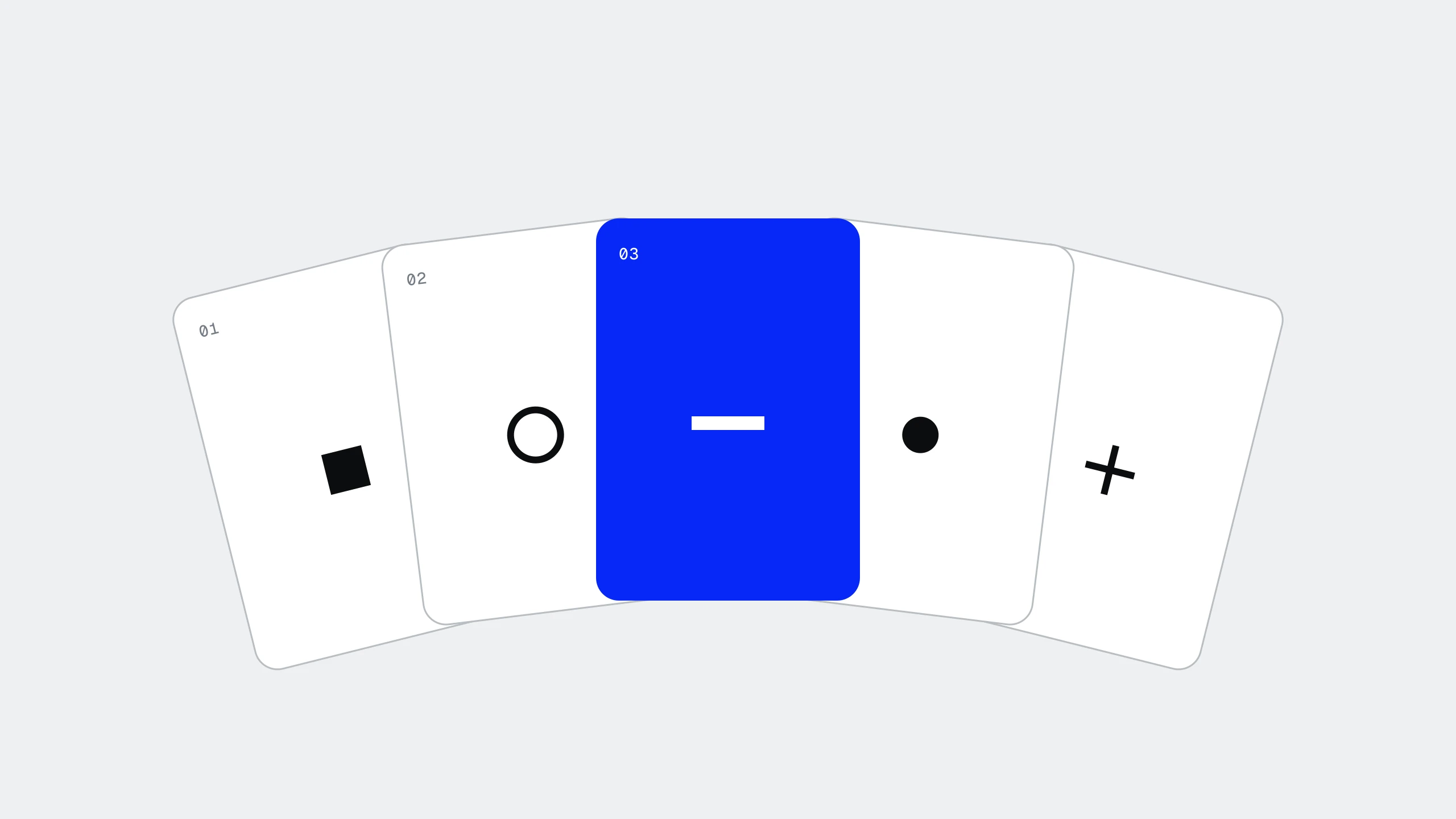
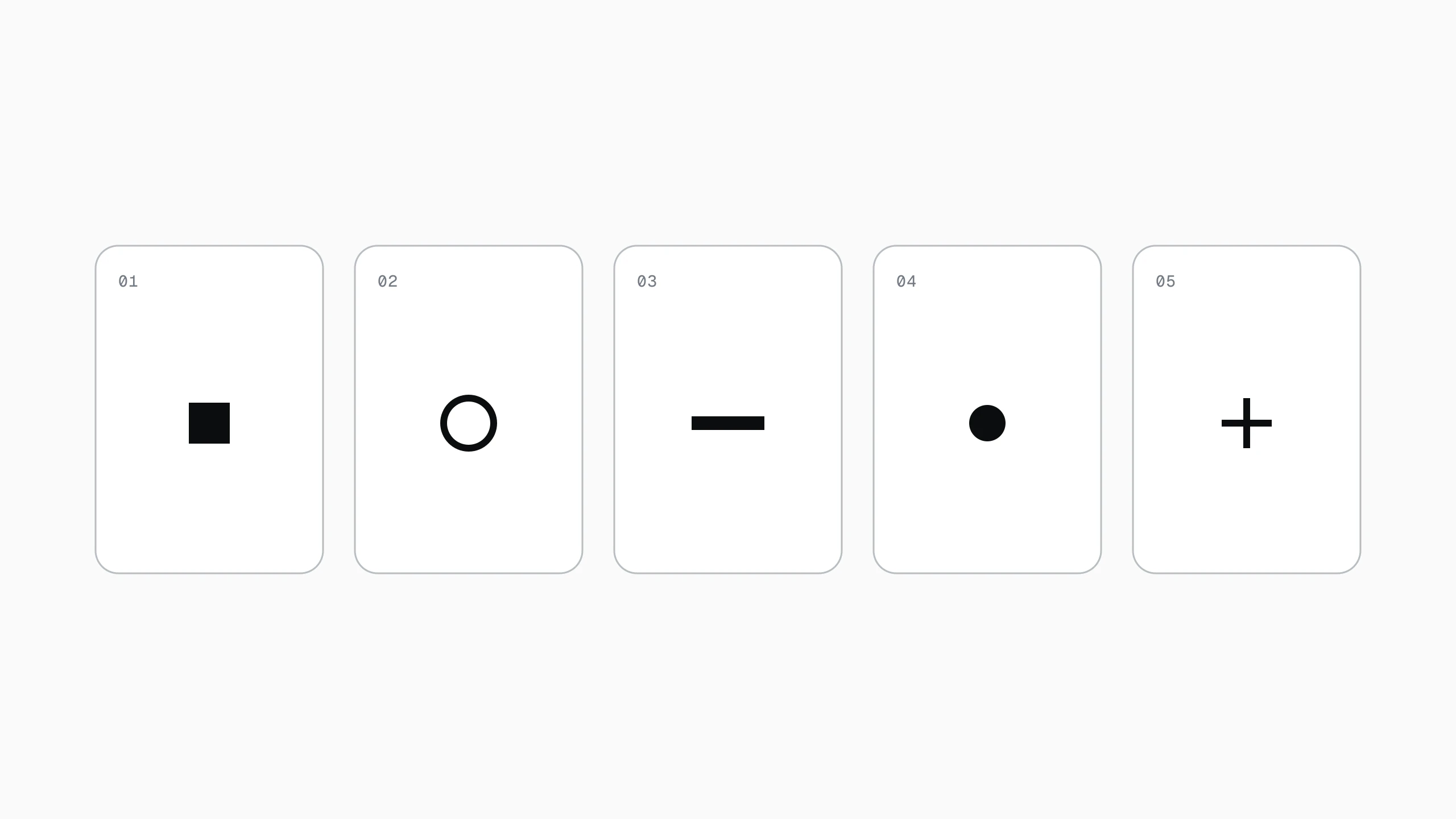
The deck began as a weekend exercise: one card, then a second that had to belong to the first. By the tenth, the cards had stopped being drawings and started being a system: a grid every face sat on, a set of marks that could be recombined, a rule for what was allowed to change.
Nothing about that was planned. The first card was a single circle on a white field, drawn because it was the easiest thing to draw. The second needed to be different, but not so different that the pair stopped looking like a pair, and that one small requirement (related, not identical) turned out to be the whole brief.
One matrix
Every symbol is drawn on the same five-by-three field of dots. It is a brutal constraint (curves are impossible, and a diagonal is a decision), but it is what makes fifty-two faces read as one family instead of fifty-two illustrations.
The matrix also settled arguments before they started. Should the hearts be rounder? They cannot be. Should the court cards get more detail? There are fifteen dots; spend them well. A constraint that strict sounds like it would slow the work down, and for the first few faces it did. After that it was the fastest tool on the desk, because most of the choices had already been made by the grid.
matrix 5 × 3pitch 12pxdot 4pxfaces 52Variation inside a rule
Fifty-two is a lot of faces for fifteen dots. The deck gets there by changing one thing at a time: the suit decides the colour, the rank decides how many dots are lit, and the court cards are the only ones allowed to break the count. Everything else (the margin, the corner index, the paper) holds still across the whole deck.
- Suit sets the colour, and nothing else.
- Rank sets the count, read left to right, top to bottom.
- Courts may break the count, never the grid.
- The corner index is the same size on every card.
When a rule bends
Written down like that it is plainly a design system, and it fails the way design systems fail. The first time a rule bent for one card, three more cards asked for the same favour within the week. The fix was the usual one: either the exception becomes a rule everyone can use, or it goes.
Printing is a deadline
Screens forgive. A card on a table does not: the ink spreads, the cut drifts half a millimetre, and a dot that read perfectly at 400% on a monitor becomes a smudge at arm's length. The final deck was redrawn twice for the press, each time with fewer, larger dots.
The proof copy is still on the shelf, with pencil marks on almost every card. It is the most useful object the project produced, more than the files and more than the finished deck, because it is the only version that shows where the system met the world and lost.
A system is only finished when it has been printed, handed to someone, and survived it.